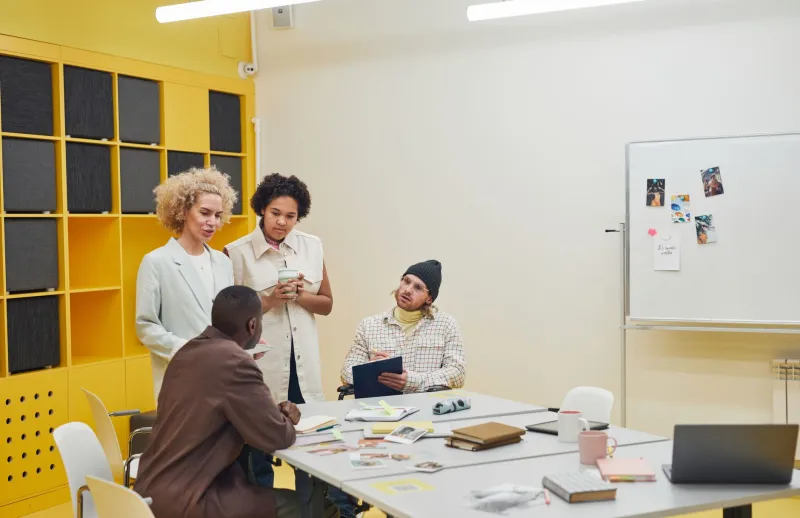
Strangers, Buzz, and Breakthroughs: The Hidden Science of Why Shared Spaces Unlock Your Best Thinking

The Weird Magic of Rooms Full of Strangers
Walk into any bustling coffee shop on a Tuesday morning and you'll notice something odd. Laptops open everywhere. People deep in focus. Nobody talking to each other, but nobody truly alone either. There's a low-grade electricity in the air—a kind of productive hum that's hard to name but impossible to ignore.
Psychologists have a name for what's happening: ambient social stimulation. And it turns out, it's one of the most powerful creativity triggers we know of.
This isn't just a vibe. It's neuroscience. And if you're a founder trying to solve hard problems, it's worth understanding exactly why your best ideas keep showing up in places designed for strangers.
The Noise Sweet Spot (It's More Specific Than You Think)
A widely cited study out of the University of Illinois found that a moderate level of ambient noise—around 70 decibels, roughly the sound level of a busy café—actually enhances creative cognition compared to both silence and loud environments. The researchers called it a "distraction-creativity paradox."
Here's the short version: total silence forces your brain into hyper-focused, analytical mode. That's great for editing a spreadsheet. It's terrible for generating novel connections. But crank the volume up too high and you're just stressed. The sweet spot—background chatter, light music, the occasional espresso machine—gives your brain just enough ambient input to loosen up its associative networks without overwhelming them.
Coworking spaces naturally land in that sweet spot. Not because they're designed to be loud, but because they're designed for people. The result is a kind of productive ambient chaos that your home office or a corporate conference room simply can't replicate.
Mild Social Pressure Is a Feature, Not a Bug
Here's something counterintuitive: being seen working makes you work differently—and often better—even when nobody's actually watching you.
Psychologists call this the "audience effect." When we're in a shared environment, even one full of strangers minding their own business, we perform a version of ourselves that's slightly more disciplined, slightly more pulled-together. You're less likely to doom-scroll for forty-five minutes when someone two seats over might glance up at any moment.
But here's the nuance that most productivity advice misses: this effect works best when the social pressure is mild and anonymous. The strangers around you aren't your boss. They're not your investors. They don't know your deadlines or your failures. That anonymity creates a kind of psychological safety net that lets you think more freely while still benefiting from the low-grade accountability of being in public.
This is the combination that traditional offices often get wrong. When your coworkers know your context, every moment of staring at the ceiling looks like slacking. In a coworking space, staring at the ceiling looks like thinking—because it is.
Anonymity as a Creative Accelerator
There's something liberating about being a stranger in a room. No one knows your company's runway. No one's watching to see if your pitch deck is any good. You're just a person with a laptop, doing your thing alongside a room full of other people doing theirs.
That anonymity strips away a particular kind of self-consciousness that can be surprisingly paralyzing for founders. When you're working from a space where your professional identity is unknown, you're free to experiment, to sketch bad ideas before good ones, to think out loud without worrying about what it signals.
Founders at Elevate CoSpace often describe a specific experience: they come in stuck on a problem, set up in a corner, and within an hour—without talking to anyone—something shifts. The environment itself seems to do something.
It does. The combination of ambient noise, mild social presence, and identity anonymity creates conditions where your brain's default mode network—the part responsible for creative insight and imagination—gets more room to operate.
How to Architect This Deliberately
Knowing the psychology is one thing. Using it intentionally is another. Here's how to set yourself up:
Claim your creative window early. Most coworking spaces have a rhythm. Mid-morning, say 9 to 11 a.m., tends to hit that ambient sweet spot—busy enough to generate the right noise level, but not so chaotic that it becomes overwhelming. Schedule your hardest creative work for this window.
Rotate your seat. This sounds minor, but changing your physical position in a space—even within the same building—resets your cognitive context. New sightlines, new peripheral activity, new ambient input. Your brain treats it like a fresh start.
Use headphones strategically, not habitually. If you plug in immediately and tune everything out, you've just recreated your home office with better Wi-Fi. Try working without headphones during ideation phases. Save them for execution tasks that need deep focus.
Let yourself be slightly uncomfortable. The creative benefit of shared spaces partly comes from a low-grade alertness that unfamiliar environments produce. If you've made your coworking desk so personalized it feels exactly like home, you may have engineered away some of the effect.
Take real breaks in the common areas. Some of the best ideas come not during focused work but during transition moments—grabbing coffee, waiting for the elevator, overhearing a snippet of someone else's conversation. Don't sprint to your phone the moment you step away from your desk.
The Environment Is Doing Work You're Not Giving It Credit For
Founders spend enormous energy optimizing their tools, their schedules, their teams. The physical environment often gets treated as a passive backdrop—something to tolerate rather than design.
But the research is clear: where you work shapes how you think, not just how comfortable you are. The strangers around you, the ambient noise, the low-stakes social presence—these aren't incidental features of a coworking space. They're active ingredients in a creativity formula that humans have been stumbling onto since the first coffeehouses opened in 17th-century London.
The difference now is that you don't have to stumble onto it. You can walk in knowing exactly what the room is doing for you—and set yourself up to get the most out of it.